
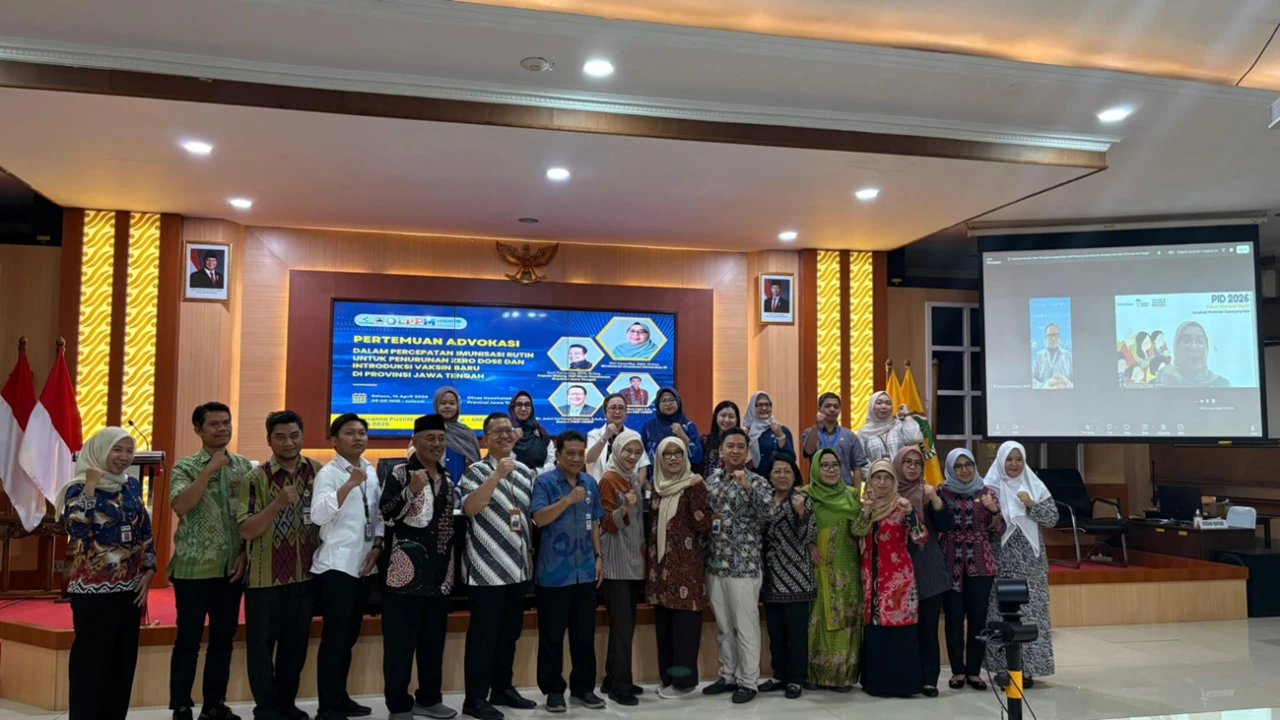

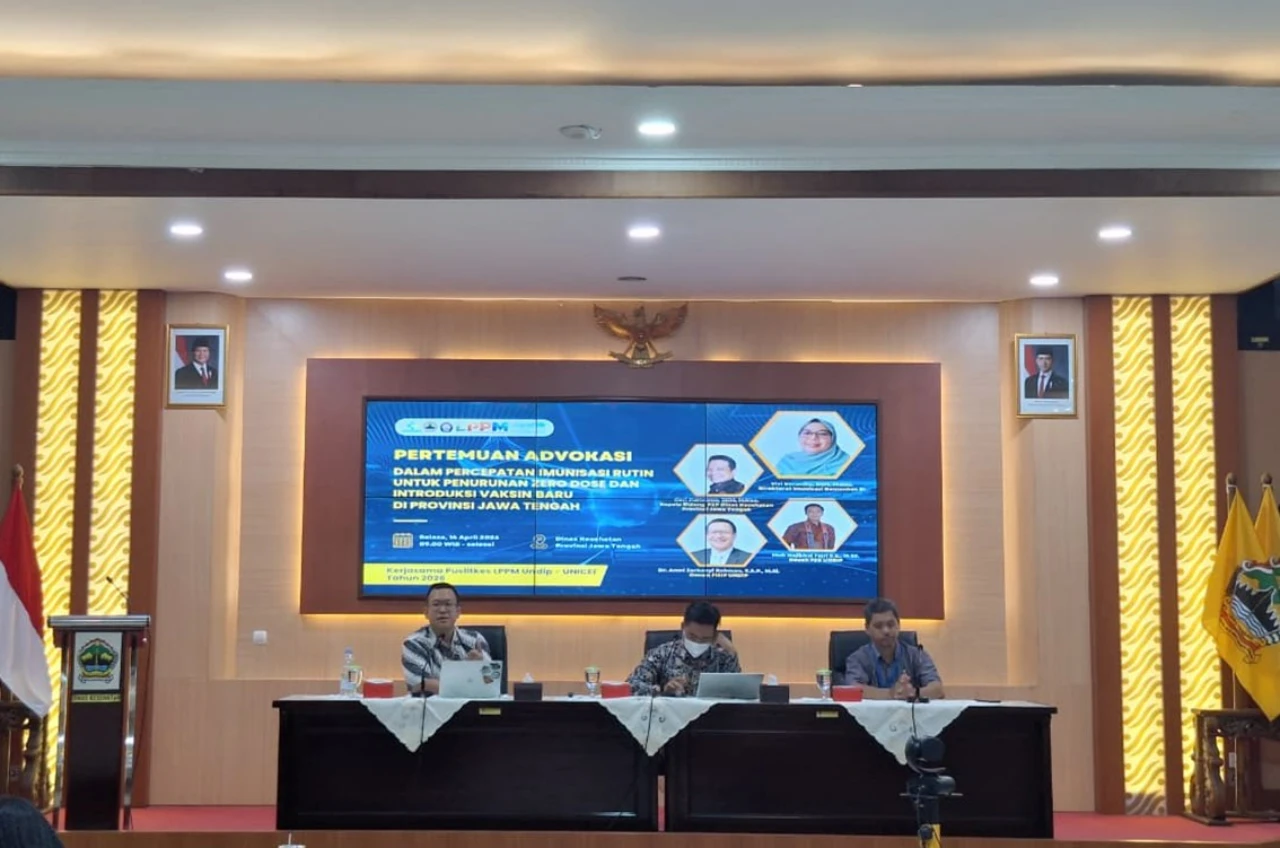
SEMARANG, April 14, 2026 – In an effort to strengthen the public health system, the Institute for Research and Community Service (LPPM) of Diponegoro University, in collaboration with the Central Java Provincial Health Office and UNICEF, held an “Advocacy Meeting for Accelerating Immunization Target Achievement” on Tuesday, April 14, 2026. Held at the Wijaya Kusuma Hall, this meeting became a crucial moment to align strategic steps in addressing the challenges of immunization coverage in Central Java.
The Urgency of Acceleration and Outbreak Mitigation
Opening the meeting, the Head of the UNICEF Indonesia Office for the Java Region, Tubagus Arie Rukmantara, who attended via Zoom, delivered remarks emphasizing the importance of extraordinary measures to restore routine immunization coverage. He stated the need for acceleration and concrete action on the ground to mitigate the risk of outbreaks (Kejadian Luar Biasa/KLB), especially after the pandemic challenges which had increased the risk of spreading vaccine-preventable diseases (VPDs).
UNICEF underscored that delays in achieving immunization targets could widen the gap in community immunity. Therefore, the cross-sector collaboration initiated through this meeting is expected to create a stronger protection mechanism for all children without exception.
Aligning Data for Evidence-Based Policy
In line with the spirit of acceleration, Dr. Amni Zarkasyi Rahman, a public governance expert from the Faculty of Social and Political Sciences, Diponegoro University, highlighted data accuracy as a primary foundation. Based on the 2025 evaluation, a significant discrepancy of 30.17% was found between manual recording and the ASIK digital system, which must be addressed immediately to avoid creating obstacles in decision-making. This condition is viewed as an administrative challenge requiring periodic data reconciliation.
“The success of immunization is not only about massive medical services but also about the precision of data governance to ensure that no child is left behind,” said Dr. Amni during his session. He emphasized that synchronization between digital data and on-the-ground realities is crucial to closing the protection gaps that are still currently identified.
Integrating the “Ngopeni” Culture into the Regional Action Plan
As a solution-oriented step, Dr. Amni, who is also a researcher at the LPPM of Diponegoro University, encouraged the implementation of a structured 2026 Regional Action Plan (RAD) for Immunization. This strategy relies not only on a technical-bureaucratic approach through the Governor’s Instruction (InGub) but also touches on sociological aspects through the local wisdom of “Ngopeni” (caring for/nurturing), aligning with the tagline of Governor Ahmad Luthfi.
The main pillars of the proposed 2026 RAD include: 1) Institutional, through the formation of a cross-sector Working Group to strengthen inter-agency coordination; 2) Data Integration, through real-time NIK validation via synergy with the Population and Civil Registration Office (Dispendukcapil) and the Communication and Informatics Office (Diskominfo); 3) Logistics, through strengthening the vaccine cold chain to maintain service quality at Community Health Centers (Puskesmas); and 4) Community Advocacy, through the active involvement of religious leaders, PKK cadres, and academics in mitigating information barriers or hoaxes related to new vaccines.
Investing in the Future through Prevention
Dr. Amni emphasized that strengthening this governance is a form of preventive investment that is far more efficient than managing outbreaks (KLB). With children still identified as not having received basic immunizations, proactive steps such as active “sweeping” by cadres at the RT/RW/village level become very crucial.
Through this advocacy meeting, Dr. Amni hopes to build a shared commitment between the Central Java Provincial Government and various community organizations to make immunization a part of the collective moral responsibility in caring for the future of Central Java’s children.

0 Comments